From the classroom to the radio: talking photography on BX1
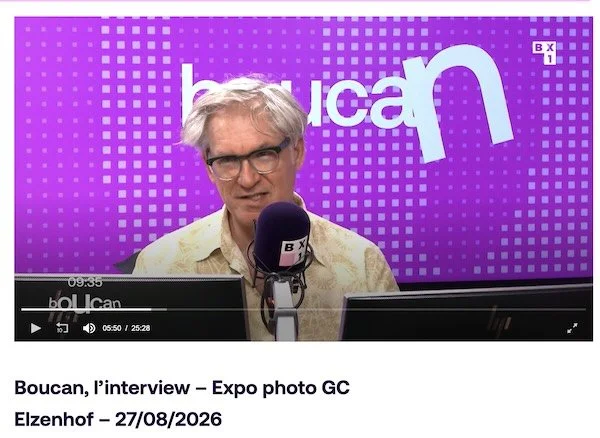
On 27 August, I had the pleasure of being invited to BX1 radio to talk about photography, teaching and the exhibition of my students' work at GC Elzenhof in Brussels.
The interview was part of Boucan, BX1's cultural programme presented by Aline Walsdorff. I was joined by two of my students, Pilar Muñoz-Elena Flores and Laurent Seghers, who also took part in the conversation about the exhibition and their experience making the photographs.
It was a nice opportunity to talk about something I enjoy enormously: helping people discover photography for themselves.
Two ways of looking at Brussels
The exhibition brings together two very different approaches to photography.
The first part is devoted to street photography. Here, the students worked with the city as their subject: looking, waiting, reacting and finding unexpected moments in the streets of Brussels. Street photography is partly about technique, but perhaps even more about being present and paying attention to what is happening around you.
The second part focuses on analogue black-and-white photography.
Working with film changes the rhythm of photography. You cannot simply take hundreds of photographs and decide later which ones work. You have a limited number of frames, and every photograph becomes a decision. Afterwards, the students also had the opportunity to experience the process of developing and printing their own photographs in the darkroom.
For me, that physical process is an important part of learning photography. You don't just see the final image; you experience how an image is made.
Why teach photography?
Teaching photography has become an increasingly important part of my work as a photographer.
I have always believed that photography is not simply about producing technically perfect images. It is about learning to look.
A photography course can give people the tools to use a camera, but the more interesting transformation happens when they start seeing their surroundings differently. A street corner they have walked past a hundred times suddenly becomes interesting. Light changes the way they see a familiar building. A stranger's gesture becomes a photograph.
That is what I hope my students take away from the courses: not just better photographs, but a different way of looking at the world.
From the street to the darkroom
I particularly enjoyed bringing these two approaches together in the exhibition.
Street photography is immediate, unpredictable and connected to the city around us. Analogue photography is slower and more deliberate. The darkroom adds another layer: the photograph doesn't really exist until you make the print.
They may seem like very different ways of working, but both begin with the same thing:
looking carefully.
And that is perhaps the most important lesson I can teach.
Listen to the interview
The conversation with Aline Walsdorff, Pilar and Laurent is available online through BX1's Boucan archive.
The exhibition at GC Elzenhof can be visited until 30 September 2026.
If you are in Brussels, come and have a look. The photographs are the result of people learning to slow down, look around them and make their own choices about what is worth photographing.
And that, ultimately, is what photography is about.
https://bx1.be/radio-chronique/boucan-linterview-expo-photo-gc-elzenhof-27-08-2026/